
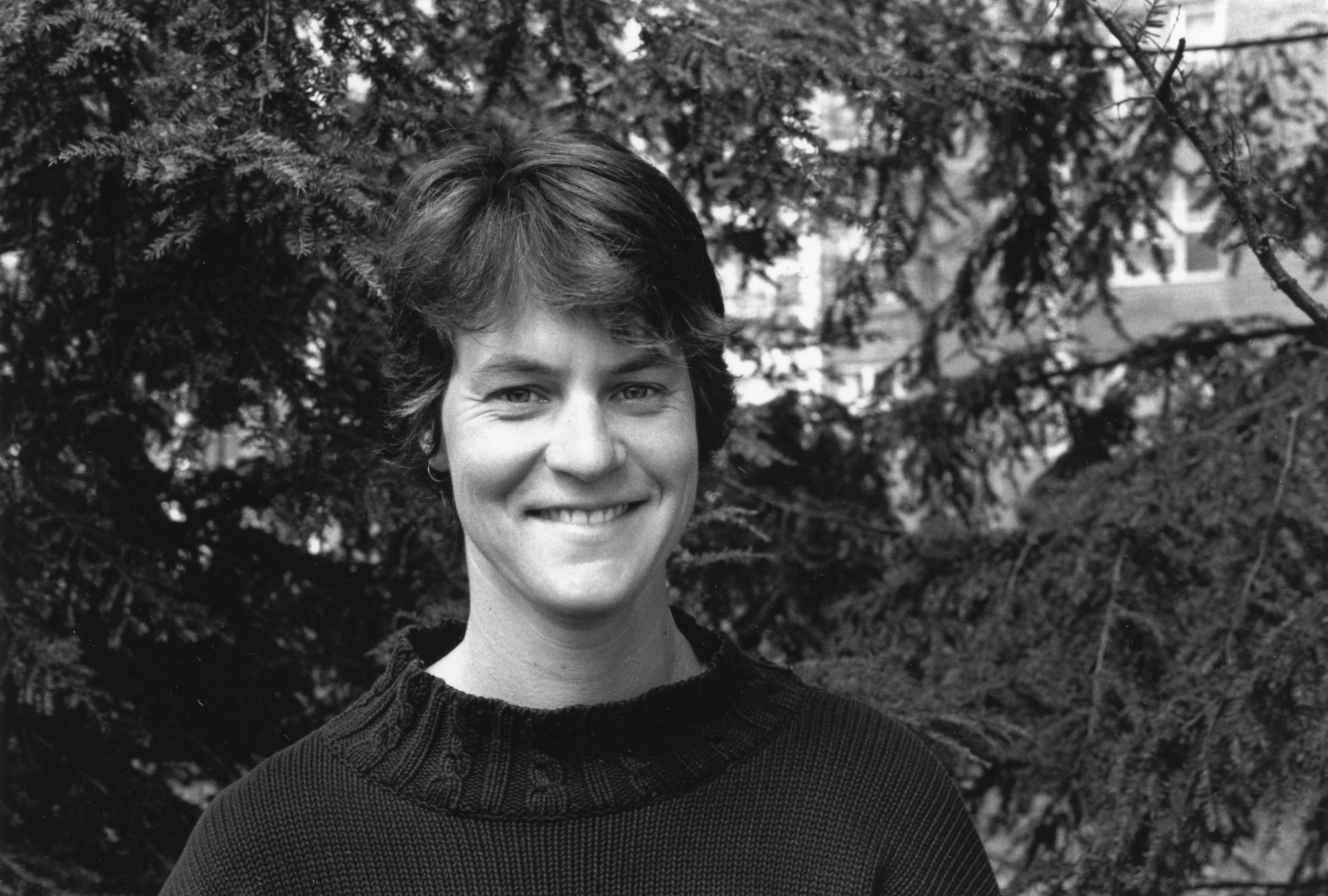
An interview with Captain Betsy Garthwaite, recipient of the Clearwater Lifetime Achievement Award
Q: Congratulations on your award! How are you feeling about it?
A: Very excited. When Steve Stanne, President of the Board, reached out and told me that they wanted to honor me with this award I was kind of flabbergasted. But I am very excited. I've been attending this event since its second or third year and it's just a lot of fun, you know. It's a beautiful venue overlooking one of my favorite stretches of the river, and you're always running into new friends, old friends, that sort of thing. It really brings out a good group of people.
Q: How did you first hear about Clearwater?
A: So, this is a funny story. One of my older brothers and sister were active with a Sea Scout post in New Hamburg. Someone from Clearwater must have come and talked to them about an early Clearwater program called the "People's Pipe Watch", which was mostly a volunteer effort to monitor every single pipe that was dripping anything into the Hudson or one of its tributaries. So my brother had learned about Clearwater and had applied to be a volunteer onboard for a week one summer, but that was a very competitive time of year when teenagers and college students are out of school. So, he actually did not get accepted to the program, primarily for the reason that they had filled up for the weeks he was available. But since then it always kind of stuck in the back of my mind. I've been living in the mid-Hudson Valley since I was 11, but I was never in one of the schools that ever went out on the boat, so I'd never seen the Clearwater before. That is, until one day I thought 'You know, I've got this week of time between my junior year of college and when I start my summer job or internship, that'd be one way to spend a week. Let me apply to volunteer on the Clearwater.' and that was it.
Q: Where did you live growing up?
A: My father worked for IBM, so we moved around a little bit. I didn't move to the area till I was 11 and my family lived kind of in the town of Poughkeepsie, so Dutchess County. I was in the Wappingers Falls Central School District.
Q: Were you interested in sailing prior to your first time aboard the sloop? What were you doing prior?
A: Ironically, I never belonged to the Sea Scout post where my brother and sister learned to run boats and sail and that sort of thing. I knew nothing, absolutely nothing. I knew how to paddle a canoe.
Q: Prior to your first time volunteering on the Sloop, did you feel like you knew where your life was going and what path you wanted to be on?
A: Well, not at all, except for one occasion when I did go out on an evening sail with the Sea Scouts, where pretty much the only thing I learned was you're supposed to wrap the line around the winch in a clockwise direction. My family didn't recreate down on the river's edge and, like a lot of people unfortunately, their perspective of the river was crossing one of the many bridges. I did grow up living in northern New Jersey where I could see the lights of the George Washington Bridge from my bedroom window. One of the storybooks that I had as a kid was called "The Little Red Lighthouse and the Great Gray Bridge", and if we were ever crossing the George Washington Bridge to visit my aunt, who lived in Manhattan, I was always trying to look over the side of the bridge to see the Little Red Lighthouse, but you can't see it from the bridge. It was really exciting to see it and to sail past it for the very first time.
Q: What inspired you to stay involved with the organization even after you no longer worked on board?
A: Honestly, I would have to say a big part of it is this extended Clearwater community. I mean, such a large percentage of the people that I know to this day are people that I met 30 years ago. And they're everywhere. I can't go anywhere in the Hudson Valley without bumping into people [from Clearwater] and that's a big part of it. I never lost my love for the Sloop or the river. I really grew to love being on the Hudson, to the extent that it almost became a spiritual experience for me. But, for a long time, I would occasionally come back as a Relief Captain when asked. I tried to stay involved by at least volunteering at the festival every year and that was always a lot of fun. I guess I decided to get active with the board when I felt like maybe there was something more I could do.
Q: What is your favorite memory of being part of Clearwater?
A: Well, I remember a sail as Sloop captain when, I believe, we were transiting with one of the sloop clubs, from possibly Garrison up to Beacon. That lower portion of the Newburgh Bay is a place where you would occasionally see windsurfers. They wouldn't come out in real light winds when it's hard to stay on your board because you're not going to go anywhere. But there are a couple of spots on the river where, especially if the wind was blowing really well, you'd see windsurfers. We were having this really pleasant summer evening sail, and it really wasn't blowing too hard. But the wind surfers were going along pretty good and, you know, your greatest fear as a captain is that one of these guys or gals is going to cross your bow, and fall right in front of you and you're not going to have time to react. But in this situation I knew these people were really experienced because I would see them out in these places in some pretty strong winds. This one man was windsurfing very close to our stern, close enough like that while he was crossing our stern he could just talk to us. And he just said to me and everybody on the helm: "Clearwater, it's because of you. It's because of you that we're out here."
It made me feel so proud because it was recognition that Clearwater and other organizations don't often get, but maybe we just don't hear it. But we need to. We need to hear it because the work that we have done for decades has been really important to people, even if it just means that they feel like the river is a place where they're not afraid to go swimming or they're not afraid to get wet. I know someone who told me that when he was a kid, if his mother found out he was anywhere near the river, he would get in a whole lot of trouble. He'd be sent to bed without dinner, that kind of thing. At that time, the river was a place that some people were very afraid of. So, it's just so nice to see that now people aren't turning their backs on the riverfront. They're actually saying, 'Oh, this is a great place to live. This is a great place to dine outside, to go fishing, or swimming, boating,' and what have you.
Q: From your all encompassing experience (community member, captain and former board/president), what would you say is the best part about this organization and the community it has built?
A: I think the best part of this organization is its determination and resilience. I think that even when we doubt ourselves, we keep pushing ahead anyway. I really feel like Clearwater is an organization that in many ways stands alone, especially amongst organizations that own and operate a tall ship. We're just, we're still here. We're still here because people believe and people, all of us, believe in the dream that was first Pete's dream. [We believe] that what we do matters. I look at the number of kids of former crew who have joined the crew or participated in restoration projects, and it's become a family and generational thing, which is also very cool. If I had kids, they'd be on board.
Q: As Clearwater's unofficial archivist, how does Clearwater's legacy inform your beliefs about its future and make you hopeful, or not, for the future?
A: Well, I think it's important to remember that Pete referred to this idea to build a Hudson River sloop as a pipe dream and that he said the only way was to get it down on paper. So when he first laid out his plan to his friend, Vick, that's really all it was at the time. It was like, wouldn't this be a cool thing to do? He wrote a 5 page letter. But one of the things about that time period is that there was so much else going on in the world that he could have said, 'I don't have time for this', you know? It was the height of anti-Vietnam war sentiment. It was the height of the sixties, the 1960s Civil Rights Movement. He was still blacklisted at this point as a performer, so where he could play or appear on television, was extremely limited. But I almost wonder if maybe that was an opportunity for him to really dig into a project that was maybe smaller, more concrete. I mean, if you think about these issues of world peace or solving racism, which mattered to him, they could seem daunting because you're this small, small part of that. But he could build a boat. He could raise money to build a boat and that would be something that he could celebrate as an accomplishment and as a success, and I know it was an important legacy to him. And we all need to remember that he used to say, "It's the million little things." It's the million little things that are gonna make the difference, that are gonna make the change. And I think that's what going forward we have to remember - that the environment and the Hudson River aren't separate little things. Everything is interwoven and he certainly recognized that. It's all about, in my mind, the planet and improving the quality of life that every living thing enjoys here.